






 简体中文
简体中文 Español
 Français
 Deutsch
 Русский
 Português
 Italiano
 日本语
日本语 한국어
한국어 العربية
 Türkçe
 Tiếng Việt
 ไทย
ไทย Indonesia
 Melayu
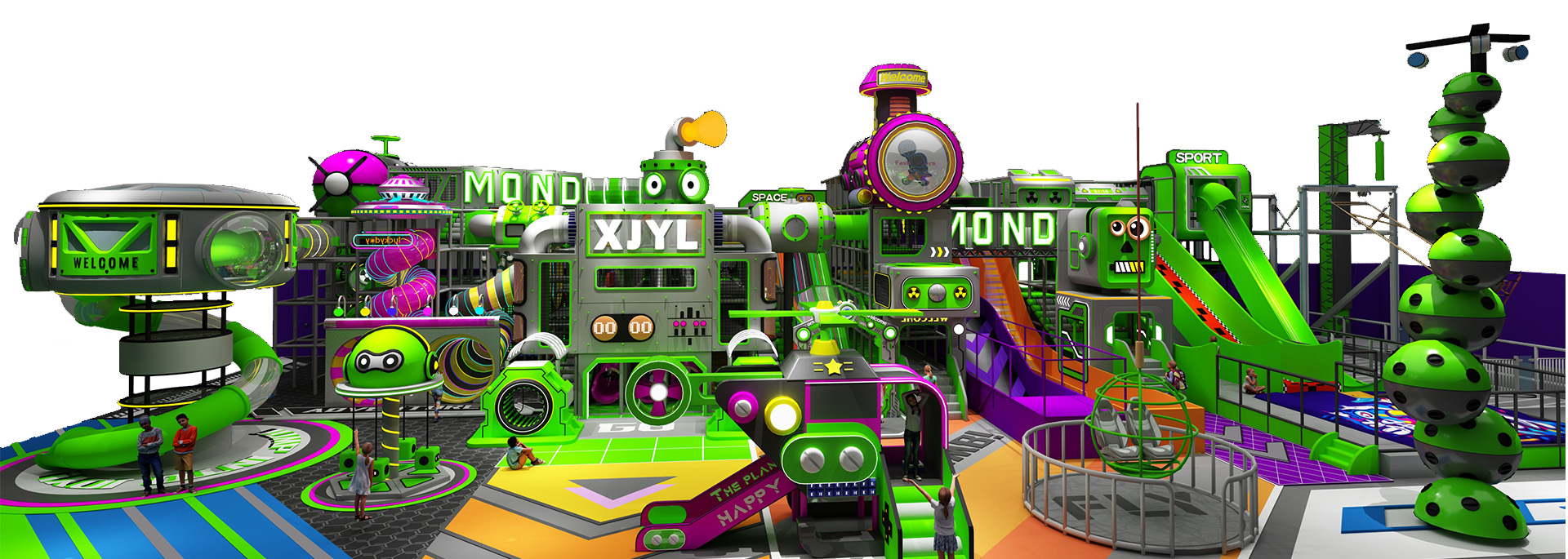
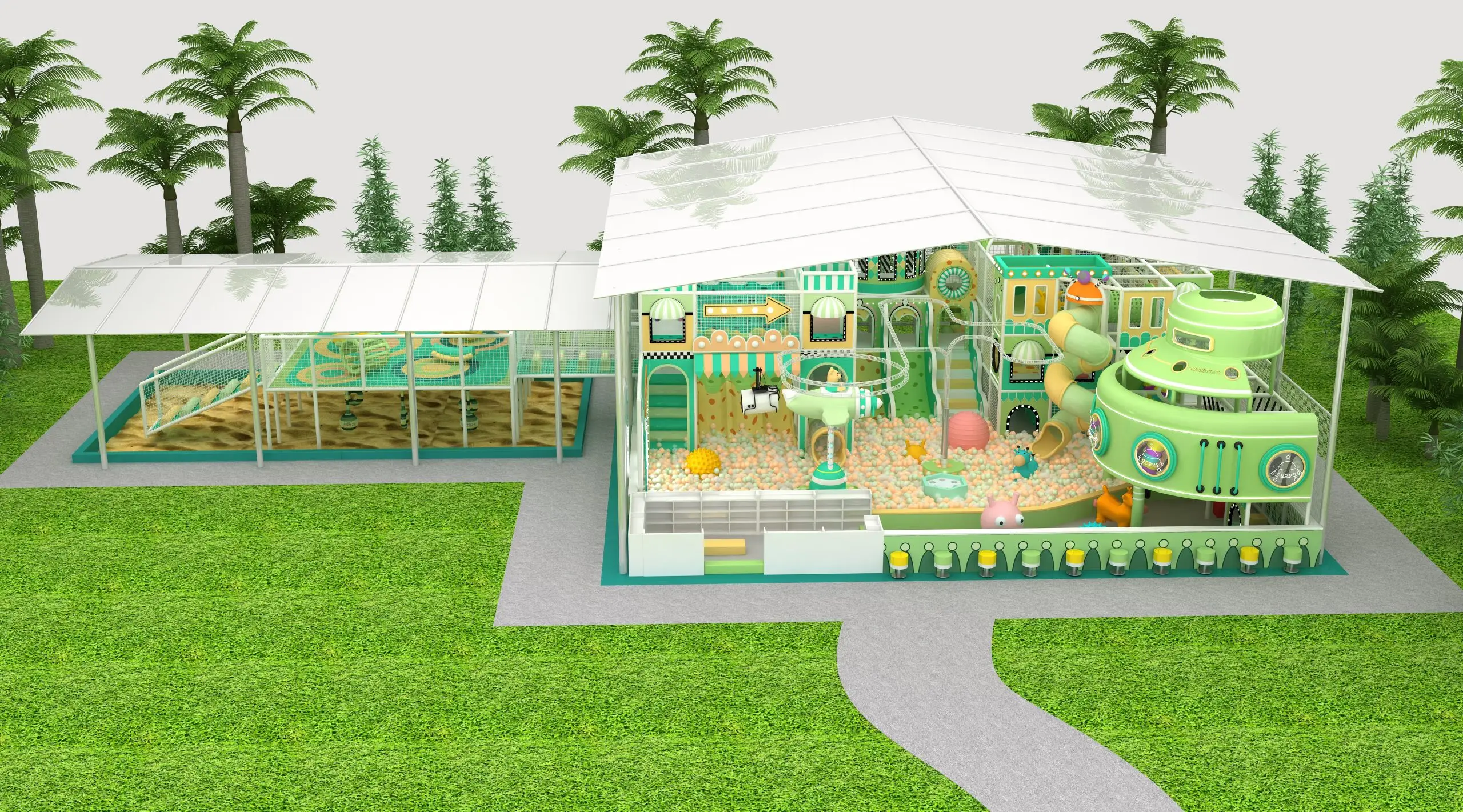
When planning a commercial indoor playground or family entertainment center (FEC), a multi-lane commercial slide is always the ultimate crowd-puller. However, operational data reveals that it is also a high-risk area for safety complaints.
While a standard slide works perfectly for a single child—where the slide’s friction and run-out zone are well-suited for their weight—the physics change drastically during parent-child tandem riding. When an adult holds a child, the combined mass doubles or triples, causing the kinetic energy to increase exponentially. Many standard slides lack proper gravitational acceleration mitigation, causing the terminal deceleration system to fail completely. This frequently results in ankle contusions, sprains, or even joint dislocations at the slide exit.
As a premier turnkey indoor playground equipment manufacturer, we combine international safety compliance (such as the European EN 1176 standard) with structural mechanics to break down the physics of tandem riding and offer a proven, actionable three-stage gradient slope custom solution.
The Mechanics Behind Ankle Injuries in Parent-Child Riding
In professional playground engineering, the exit speed of a slide is not determined by height alone. Total mass, center of gravity, and the coefficient of friction play critical roles:
- Mass Accumulation Triggers Kinetic Energy Surges According to the kinetic energy theorem, doubling the mass means doubling the kinetic energy. A single child is easily slowed down by air resistance and slide surface friction. However, the immense inertia of an “adult + child” duo easily overcomes these standard resistances. The exit speed often skyrockets from a safe sub-$2\,\text{m/s}$ range to over $3.5\,\text{m/s}$, far exceeding the protective threshold of standard floor padding.
- Shifted Center of Gravity and “Shearing Force” When riding with a child, adults naturally lean back, shifting the overall center of gravity backward and upward while extending their feet forward. If the slide’s deceleration zone is insufficient, the rider’s feet slam into the exit safety mat at high speed while their torso continues to rush forward due to inertia. This creates a severe shearing force on the ankles, leading to immediate injury.
- Flaws of Traditional Straight-Slope Designs Most standardized commercial slides on the market feature a single, linear incline with no kinetic energy dissipation structure. This design dumps 100% of the deceleration pressure onto the floor mats at the exit. It is a passive, flawed approach that fails to tackle the root cause of the impact.
The Solution: Three-Stage Gradient Slope & Gravitational Acceleration Mitigation
To fundamentally eliminate ankle injury risks, custom commercial slides must optimize slide curvature and force distribution. Our engineering team utilizes a three-stage gradient slope structure to dissipate kinetic energy sequentially:
1. Entry Incline Zone: Locking in the Initial Safe Speed
The beginning of the slide is where kinetic energy starts to build. We strictly lock the initial inclination angle of our multi-lane slides between 30° and 35°, fully complying with international safety codes. We never increase the initial slope just to chase cheap thrills, as doing so doubles the initial gravitational force, making it impossible for the bottom buffers to recover. Additionally, high-barrier guardrails are integrated at the entrance to force proper riding postures, preventing dangerous behaviors like sliding headfirst or lying down.
2. Transition Zone: Large-Radius Curvature to Dissipate Vertical Impact
Low-end slides often use sharp joints or small angles to connect the slope to the base, causing a jarring bump that can injure a rider’s tailbone or lower back. Our custom solution utilizes a smooth, parabolic arc structure with a radius of $\ge 100\,\text{cm}$ in the transition zone. This seamless curvature smoothly converts vertical gravitational potential energy into horizontal forward momentum, naturally dissipating over 30% of the kinetic energy mid-ride.
3. Run-out Zone: Extended Horizontal Deceleration for Zero-Impact Landing
The bottom run-out section is the final line of defense for the ankles. For multi-lane slides with a height exceeding 3 meters, we customize an extended horizontal run-out zone of 150–200 cm, paired with a 1°–2° reverse micro-incline. By leveraging the mechanical friction of the slide bed, the remaining kinetic energy is completely exhausted, bringing the terminal velocity well within safe compliance metrics and eliminating the “foot-catching” effect at the exit.
Commercial Multi-Lane Slide Customization Parameters (Safety Standards)
When sourcing playground equipment, use these metrics to differentiate professional safety engineering from subpar manufacturing:
| Slide Structural Zone | Professional Custom Parameters (EN 1176 Compliant) | Common Defects in Low-End Equipment | Core Mechanical Engineering Logic |
| Entry Incline | 30° – 35° angle, smooth surface without joints | Incline exceeds 40° purely for extreme speed | Controls initial gravitational force; prevents excessive starting kinetic energy. |
| Transition Zone | Arc radius $\ge 100\,\text{cm}$, smooth parabolic transition | Sharp angles or welded joints; highly jarring | Smoothly redirects forces; protects the spine and joints from sudden impact. |
| Run-out Zone | Effective length 150 – 200 cm, 1° – 2° reverse micro-incline | Only 60 – 80 cm long; no deceleration structure | Extends friction deceleration distance; fully dissipates combined mass momentum. |
| Exit Clearance | 20 – 30 cm above the floor, matching safety mat standards | Too high (hard drop) or too low (foot catching) | Eliminates landing shearing forces; eradicates ankle contusion risks. |
| Side Sidewalls | Height $\ge 50\,\text{cm}$, integrated raised design | Low sidewalls; high risk of flipping over | Stabilizes the high center of gravity during tandem riding; prevents side-slipping. |
Site Layout Optimization: Building a Secondary Line of Safety
Beyond the slide’s structural mechanics, the surrounding environment dictates final safety outcomes. During the delivery and installation phases, we provide a comprehensive site integration strategy:
- Exclusive High-Density Safety Padding: Standard interlocking EVA mats are strictly prohibited at the slide exit. The exit zone must feature a professional 20cm+ high-density, slow-rebound landing mat that fits seamlessly against the slide lip to eliminate any foot-trapping gaps.
- Zoned Material Optimization (For Compact Venues): If space constraints prevent an extended run-out zone, we utilize a dual-material setup. The upper sections use high-gloss stainless steel for an exciting ride, while the final 1-meter run-out zone integrates a high-friction soft-wrapped material to force rapid, passive deceleration.
- Standardized Compliance Signage: Clear, highly visible safety signage is installed at the entrance, explicitly stating maximum weight limits, proper riding positions, and strict rules against holding infants. This mitigates operational liability and legal risks from day one.
Custom Indoor Slide Design: FAQ
Q: Our indoor playground has limited space and cannot accommodate a 2-meter horizontal run-out zone. How can we ensure safety for parent-child riding?
A: You don’t have to compromise on safety or shrink your layout. For tight spaces, we implement our Zoned Material Deceleration Solution. While maintaining the correct entry incline and transition arc, we swap the final 1 meter of the run-out bed with a high-resistance, anti-slip soft-wrapped material. This uses local mechanical friction to force the terminal velocity down to safe parameters, making it ideal for compact commercial venues.
Q: Will optimizing the slope for deceleration make the slide boring or reduce its popularity among children?
A: Not at all. The three-stage gradient design only optimizes the very end of the slide for landing safety. The speed, smoothness, and thrill of the mid-ride remain fully intact. To boost play value, we can also incorporate a gentle wave contour (Wave Slide) into the middle section, enhancing the riding sensation within completely safe parameters.
Q: Can your multi-lane commercial slides be fully customized to match our exact floor plan, ceiling height, and width?
A: Absolutely. We specialize in providing turnkey indoor playground solutions. Our engineering team calculates and adjusts the slope angles, arc radii, run-out lengths, and lane widths based on your exact architectural CAD drawings, ensuring your custom slide is visually stunning while remaining 100% compliant with international safety testing standards.