







 简体中文
简体中文 Español
 Français
 Deutsch
 Русский
 Português
 Italiano
 日本语
日本语 한국어
한국어 العربية
 Türkçe
 Tiếng Việt
 ไทย
ไทย Indonesia
 Melayu
As indoor amusement venue stock competition becomes increasingly fierce, the traditional operation model relying on simple amusement equipment stacking and fixed scene layout can no longer meet the needs of modern family consumption and commercial site profitability requirements. The core logic of modern indoor playground design has been fully upgraded in 2026, shifting from a single child entertainment function to an integrated commercial layout integrating immersive scene creation, all-age group customer adaptation, intelligent operation empowerment, and low-cost long-term operation, which has become a key breakthrough for commercial real estate, parent-child cultural tourism and community supporting projects. At present, end customers focus not only on the quantity of amusement equipment, but also on play experience, space texture, safety guarantee and accompanying experience. Meanwhile, investors and venue operators pay more attention to indoor playground space efficiency improvement solutions, user repurchase retention rate, long-term operation and maintenance cost control and compliance operation guarantee. It can be said that the new generation of profitable indoor playground is an in-depth integration of experience, social interaction, safety, data and commercial value.
According to the global indoor play project implementation data, more than 80% of high-quality profitable newly-built and renovated parent-child parks, FEC family entertainment centers and shopping mall amusement venues have completed the upgrading of design systems, completely abandoning the homogeneous traditional layout. This article deeply analyzes the five mainstream innovative indoor playground design trends in 2026, and outputs directly implementable planning solutions combined with different venue formats, safety compliance standards and return on investment models, helping project parties build a sustainable operation system with high traffic, strong stickiness and high ROI from the initial stage of spatial design.
2. Top 5 Core Innovative Indoor Playground Design Trends 2026
Trend 1: Cyber Tech Immersive Sensory Space to Build Long-term Social Communication Barriers for Venues
With the continuous enhancement of the social attribute of parent-child consumption, immersive light and shadow interactive play scene design has become the core standard configuration of high-end indoor playgrounds. Traditional static amusement equipment has problems such as single experience, weak memory points and serious homogenization, which are difficult to stimulate users’ spontaneous communication willingness. In contrast, the immersive sensory space integrated with digital technology breaks the visual and experience boundaries of traditional play scenes through the integrated integration of software and hardware, creating differentiated core competitiveness.
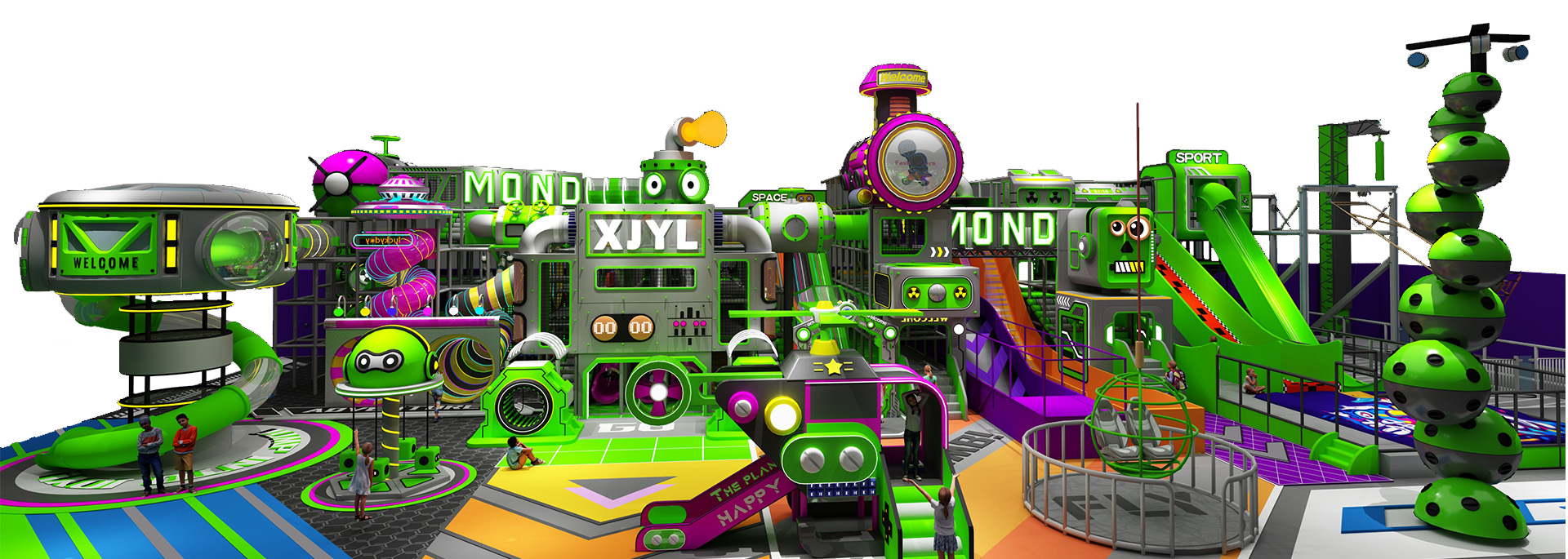
In terms of landing application, new-generation venues focus on integrating AR intelligent interactive play systems, high-definition holographic projection scenes, integrated induction LED screens, dynamic light and shadow induction walls, and ground interactive game systems. Different from simple additional interactive equipment installed in the later stage, professional commercial design deeply integrates digital systems with play structures, space moving lines and theme scenes, realizing full-domain interaction on walls, grounds, passages, slides and challenge equipment, and triggering multiple experiences such as light and shadow transformation, interesting sound effects, interactive games and dynamic special effects to create a multi-level and three-dimensional immersive play scene.
In terms of commercial value, indoor venues with Internet-famous immersive play scenes naturally have social communication attributes, which can provide high-quality checking-in materials for parents and greatly improve the probability of users’ spontaneous sharing, short video communication and word-of-mouth recommendation. According to the data of implemented projects, the natural online exposure of playgrounds with full-domain immersive technology is increased by more than 65% compared with traditional playgrounds, and the new customer acquisition cost is reduced by 40%, which effectively solves the core pain points of difficult passenger flow drainage and low brand recognition of commercial venues. Meanwhile, it adapts to diverse commercial scenarios such as holiday activities, theme parties and study tour team building to expand profit channels.
Trend 2: Biophilic & Nature-Friendly Design to Upgrade High-End Family Leisure Experience Texture
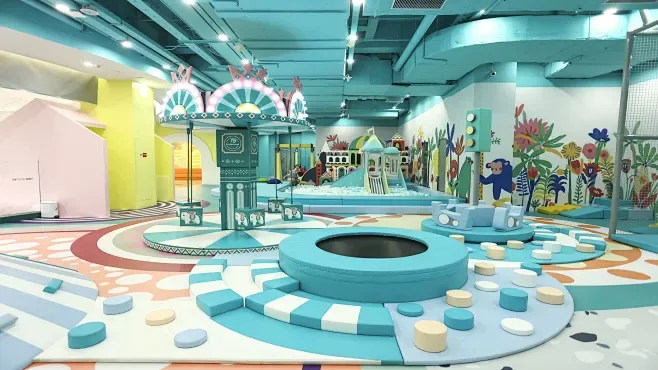
Most traditional indoor playgrounds adopt high-saturation bright color matching, which has a strong visual impact but easily causes aesthetic fatigue. Especially, it makes parents who accompany children for a long time feel irritable and depressed, directly shortening the staying time of family customers. The biophilic play space design in 2026 completely subverts the color aesthetics and spatial style of traditional venues, and has become the mainstream choice for high-end shopping malls, high-quality community playgrounds and premium parent-child venues.
Centering on minimalism and nature, this design trend abandons exaggerated color stacking, and fully adopts Morandi low-saturation color system, log texture materials, soft arc lines, simulated green landscape and natural light simulation lighting system. In terms of spatial layout, it weakens the noisy commercial sense of amusement venues, adds quiet buffer areas, parent-child leisure areas and green landscape areas, and realizes a balanced collocation of play space and leisure space. At the same time, environmentally friendly log soft bags, matte flame-retardant materials and transparent soft-light ceilings are selected to take into account visual texture, environmental safety and comfortable experience.
For B2B project parties, high-end natural-style indoor playground decoration solutions can not only accurately match the aesthetic needs of high-end young families and improve the overall grade and brand tone of venues, but also effectively extend the staying time of accompanying parents, enhance user favorability and membership renewal rate. Compared with traditional noisy amusement venues, natural-style spaces are more suitable for long-term immersive consumption, helping venues build high-end, warm and safe brand labels, distinguish from low-cost homogeneous playgrounds, and raise overall unit price and brand premium.
Trend 3: Multi-Layer Vertical Layout to Optimize Space Efficiency of Small-Area Venues
With the continuous rise of commercial real estate rent in core urban business districts, most indoor play venues have the problems of limited area, insufficient flat space and single available projects. The traditional indoor playground space planning scheme with single-layer flat layout has long reached the ceiling of space efficiency, failing to maximize site value. In this context, vertical multi-layer play space design has become the core cost-effective solution for small-area play projects to increase revenue and efficiency in 2026.
Relying on the original floor height advantage of the site, this layout mode adopts modular steel structure, safety net cages, aerial plank roads and layered challenge passages to vertically expand play space without expanding the ground area, and three-dimensionally divide challenge areas, leisure areas, interactive areas and checking-in areas. Professional design will strictly control the rationality of moving lines, completeness of care vision and fluency of traffic evacuation in vertical space, avoiding common hidden dangers such as congestion, blind areas and safety risks caused by multi-layer layout. Meanwhile, the layered height is customized according to the site floor height to adapt to children’s play scale and safety specifications.
From the perspective of commercial operation, the vertical composite layout can increase the play items, experience lines and passenger flow capacity of the same area site by more than 45%, greatly improving the space utilization efficiency of indoor venues and effectively hedging the high rent cost of commercial sites. Whether it is a 100㎡ small community playground or a large shopping mall main amusement venue of more than 500㎡, customized vertical layout can realize the operation effect of small space, multiple projects and high passenger flow, which is the optimal layout method for stock venue renovation and low-cost revenue increase of new stores at this stage.
Trend 4: Full-Age Inclusive Zoning Design to Extend Family Customer Retention & Consumption Cycle
Most traditional indoor playgrounds adopt undifferentiated general layout, which cannot adapt to the play needs of children of different age groups. Young children are afraid to participate in high-risk projects, while older children feel the facilities too naive, resulting in poor family customer experience, short staying time and low repurchase willingness. The new industry-standard full-age parent-child playground zoning planning in 2026 covers the needs of all family members through refined age segmentation and functional zoning, completely solving the pain point of insufficient customer group adaptability.
The scientific zoning system divides four core areas strictly according to children’s growth characteristics and behavioral habits, taking into account playability, safety and companionship:
- 0-3 Years Old Toddler Sensory Soft Play Area: Fully rounded soft package protection, low-height play facilities, quiet environment and tactile interactive equipment are adopted to focus on toddler sensory development and limb coordination training, avoiding collision and pinch injuries to meet the safe play needs of infants.
- 4-10 Years Old Comprehensive Play Area: Equipped with slide combinations, ball pits, role-playing, puzzle challenges and other classic facilities, covering the mainstream play needs of children, serving as the core drainage area of the venue.
- 10-16 Years Old Teenager Competition Challenge Area: Built with ninja challenges, high-altitude expansion, balance training and physical fitness advanced projects to meet the exploration and competition needs of older children, filling the gap of older customer groups in traditional playgrounds.
- Exclusive Parent Companion Leisure Area: Equipped with charging facilities, leisure seats, tea and coffee counters and viewing areas, allowing parents to rest, work and relax during companionship, completely solving the pain point of “tiring companionship”.
This inclusive play space design can extend the average family staying time from 1-2 hours to 3-5 hours, greatly lengthening the consumption window, effectively driving secondary consumption such as birthday parties, parent-child packages, cultural and creative retail, and light catering, significantly increasing per capita output value and comprehensive profitability of the venue, and building the core reputation of “one-stop play for the whole family”.
Trend 5: Data-Driven Intelligent Facility Integration to Realize Refined Intelligent Venue Operation
In the stage of industry stock competition, the model of relying solely on hardware facilities to attract customers has come to an end. intelligent indoor playground operation system integration has become the core support for long-term profitable venue operation. High-quality play projects in 2026 have realized the integrated design of hardware facilities and intelligent operation systems in advance, instead of installing intelligent equipment in the later stage, building a digital management system from the source of planning to help operators accurately control operation data, reduce operation and maintenance costs, and optimize operation strategies.
The mainstream implementation configuration includes RFID intelligent bracelet management system, full-site passenger flow thermal monitoring sensors, equipment operation intelligent monitoring modules, member data management background and dynamic pricing system. All intelligent equipment is designed synchronously with venue structure, circuit layout and moving line planning, realizing full-process automation of admission verification, play timing, consumption recording, member points, passenger flow statistics and equipment operation and maintenance early warning. The background can generate multi-dimensional operation reports such as passenger flow peak statements, popular project data, regional idle rate and equipment loss data in real time.
Relying on this data-driven playground management solution, operators can realize refined operation: adjust business hours and dynamically optimize ticket pricing system according to passenger flow data, carry out targeted member marketing activities; predict faults in advance and arrange maintenance according to equipment operation and maintenance data to reduce shutdown losses; optimize venue moving lines according to regional idle data to activate inefficient spaces, comprehensively reduce labor costs and operation and maintenance losses, and improve the refined management level and long-term profit stability of venues.
3. Trend Implementation Operation: Convert Design Solutions into Long-Term Commercial Value
3.1 Scenario-Based Trend Adaptation: Differentiated Design Strategies for Different Venue Formats
The five major design trends are not universal templates. Blindly stacking high-end designs and equipment will lead to excessive investment cost, insufficient adaptability and unbalanced ROI. It is necessary to adapt to local conditions and match the optimal design scheme according to venue format, area and customer positioning. The following is the comparison table of custom indoor playground design strategies for different mainstream venues:
| Venue Type | Core Design Focus | Equipment & Scene Adaptation Solution | Core Profit Goal |
|---|---|---|---|
| Shopping Mall Main Store (Above 300㎡) | Scene differentiation, brand exposure, full-age adaptation | Integrate immersive light and shadow technology, multi-layer vertical layout and complete full-age zoning, build themed scenes, and support exclusive party areas | Undertake natural mall passenger flow, build landmark business formats, and increase unit price and brand influence |
| Community Supporting Store (Within 300㎡) | Cost performance, high-frequency repurchase, lightweight operation | Prioritize natural aesthetic design, lightweight vertical layout and simple intelligent verification system, and reduce high-end technology equipment investment | Lock in surrounding family members, and realize long-term profitability with high frequency, stable repurchase and low operation cost |
| Cultural Tourism FEC Center | Check-in communication, theme characteristics, one-time high consumption | Fully implement cyber immersive scenes and characteristic competition projects to strengthen visual memory points and social attributes | Adapt to floating tourist customer groups, increase single consumption output value, and quickly recover investment costs |
3.2 Standardized Safety Compliance Implementation to Avoid Operation Risks
For commercial play projects, safety compliance is the underlying foundation of all design and profitability. international indoor play equipment safety compliance design is the core prerequisite for project implementation, review and operation. No matter how innovative the scene and upgraded the technology, it must strictly comply with global universal safety standards, and avoid potential safety hazards and compliance risks from the dimensions of design, material selection, structure and protection.
At present, the mainstream authoritative industry standards include North American ASTM F1487, ASTM F1918 play equipment safety standards and European EN 1176 series of venue and equipment safety specifications, covering more than 100 core indicators such as structural load-bearing, anti-pinch protection, fall buffer thickness, environmental protection and flame retardant materials, emergency evacuation passages and equipment load limits. Professional commercial design completes compliance verification in the drawing stage, selects certified environmentally friendly flame-retardant materials, and standardizes the design of rounded protection, buffer mats, emergency passages and isolation protection structures to eliminate potential safety hazards from the source and ensure the project passes venue review and operates in compliance smoothly.
3.3 Pre-Project ROI Calculation to Optimize Full-Life Cycle Cost
High-quality indoor playground design not only pursues the upgrading of vision and experience, but also focuses on full-life cycle operation and maintenance cost control and return on investment efficiency. Many projects blindly stack high-end equipment in the early stage, resulting in excessive investment cost, cumbersome later operation and maintenance, prolonged payback period and ultimately difficult profitability. Therefore, ROI calculation must be advanced in the design stage to optimize equipment combination and spatial layout.
The mature cost reduction and efficiency improvement design ideas include three core key points:
- Adopt modular and standardized equipment components, support individual replacement of damaged parts without overall demolition and replacement, greatly reducing later maintenance and renovation costs;
- Intelligent systems adopt remote operation and maintenance models with online fault early warning and remote debugging functions, reducing offline on-site maintenance frequency and saving labor operation costs;
- Balance the proportion of drainage equipment and basic supporting equipment, strictly control the total initial investment budget, avoid excessive investment, and adapt to the venue passenger flow volume.
Measured by multiple projects, indoor playground projects with scientific design and cost control can stably control the investment return cycle within 18-30 months, reduce full-life cycle operation and maintenance costs by more than 30%, and greatly improve profit stability.
4. FAQ
Q1: Do small community indoor playgrounds need to be equipped with immersive AR interactive equipment?
Full sets of configuration are not required. The core demands of small community stores within 300㎡ are low cost, stable repurchase and easy operation. Lightweight wall-mounted projection equipment can be matched as check-in highlights without investing in high-cost full-domain light and shadow equipment. The budget should be prioritized for vertical space optimization and full-age zoning design to balance experience and cost performance and avoid redundant costs.
Q2: Will natural Morandi color design reduce children’s play attraction?
No. The natural style design takes low-saturation soft tones as the base, and can match partial bright interactive devices and colored play modules to form visual layers, taking into account high-end texture and children’s play fun. Meanwhile, this design is more in line with parents’ aesthetics, effectively improving accompanying experience and repurchase rate, with far higher overall commercial value than traditional high-saturation noisy design.
Q3: Will multi-layer vertical layout greatly increase the overall project cost?
The incremental cost is controllable with higher long-term cost performance. The vertical layout only increases a small amount of steel structure support cost, but can greatly increase play items and passenger flow capacity in a limited area, effectively diluting the rent and unit investment cost per passenger flow. It is the optimal solution for small-area venues to improve space efficiency, and the long-term profit income is far higher than the small incremental initial investment.
Q4: Is the later operation and maintenance of intelligent RFID operation system difficult?
The operation and maintenance difficulty is extremely low, suitable for small and medium-sized venues and chain stores. The integrated intelligent system has built-in remote fault early warning and automatic data statistics functions, no professional technical personnel on-site duty is required, and only basic verification and data export operations are needed in daily operation, which can effectively simplify venue management processes and reduce labor operation costs.
Q5: Will full-age zoning design waste venue space?
No space waste will be caused. Refined zoning can accurately match the needs of different customer groups, activate all venue areas, avoid congestion in a single area and idleness of partial areas, maximize the utilization of every inch of venue space, and extend user staying time to improve comprehensive consumption income.
5. Conclusion
The core competitiveness of commercial indoor playground design in 2026 has long been separated from simple equipment competition, and turned to comprehensive strength competition integrating experience texture, space efficiency, customer adaptation, intelligent operation and compliant profitability. The five major trends of cyber immersive technology, natural biophilic aesthetics, vertical space efficiency optimization, full-age inclusive zoning and data intelligent operation complement each other, forming a complete design system for new-generation profitable playgrounds.
For project investors and venue operators, only by adapting to local conditions to implement cutting-edge design trends combined with their own venue format, area conditions and customer positioning, while taking into account safety compliance, cost control and ROI return, can we build differentiated advantages in homogeneous stock competition and achieve long-term operation with high traffic, strong stickiness and stable profitability.
If you are preparing for new construction or renovation and upgrading of indoor playground projects, and want to obtain exclusive custom indoor playground design solutions, venue layout drawings, equipment budget lists and compliance standard lists, please contact the professional planning team of Ledi to get one-on-one free project consultation and implementation guidance.